
UK hospitality continues to operate under intense hiring pressure. With tens of thousands of vacancies across the sector in recent years, persistent labour shortages post-Brexit, and one of the highest turnover rates in the UK economy, HR teams are being asked to do more with fewer resources and to do it faster. Yet despite heavy recruitment activity, many roles remain open longer than expected, quality applicants drop off mid-process, and early attrition continues to rise. The issue isn’t simply candidate scarcity.
In many cases, the real problem lies within the recruitment process itself. The hospitality hiring funnel is leaking talent at multiple stages, from attraction to onboarding, costing HR teams time, budget, and credibility. This article breaks down exactly where those leaks occur and what practical steps hospitality HR professionals can take to fix them.
Think of the hiring funnel as a series of stages:
In a healthy funnel, each stage smoothly hands off to the next. But in hospitality today? There are leaks at nearly every step. Here’s a breakdown of what happens in every stage:
Despite a huge need for workers (think tens of thousands of vacancies), many hospitality jobs go unnoticed or ignored by job seekers.
This happens for several reasons, some of which include:
This means candidates might see the role but still skip it, and as HR knows, fewer qualified applicants means increased time and cost to fill positions.
Once attracted to a job, candidates rapidly decide whether to apply, and many abandon before completing the process. Here are the key causes of application drop-off
A hospitality job should be simple to apply for, especially since many workers use mobile phones as their primary job-search tool. Any friction here pushes candidates into “easy apply elsewhere” mode.
Pro Tip: Simplify your application process. If candidates hit a roadblock before submitting, you’ve lost them before you even meet them.
Let’s be honest, many hospitality screening processes lean heavily on outdated assumptions:
This creates two problems:
a) False negatives
Good candidates who don’t tick every box get filtered out.
b) Inefficient HR time
Hours spent digging through CVs that don’t accurately predict job success.
A better screening process integrates skill-based questions, quick mobile assessments, and pre-screening calls that filter quality candidates without draining HR time.
One of the biggest leaks in the hiring funnel is time-to-offer. In today’s job market, hospitality candidates are interviewing for multiple roles at once. If your process is slow:
Even a wait of a few days between screening and interview can cost you the candidate.
Pro Tip: Aim to schedule interviews rapidly, ideally within 24–48 hours of an application.
Recruitment ghosting isn’t just a buzzword. It’s real. Candidates may interview and then:
While ghosting is frustrating, it often signals issues with the candidate experience during the hiring process:
HR teams that keep candidates engaged with regular updates and clear next steps dramatically reduce no-shows at this stage.
Even after a candidate accepts, the job isn’t done. Poor onboarding stacks the deck for early turnover.
Common onboarding problems include:
Given hospitality’s already high turnover (estimated to be much higher than most other UK sectors), effective onboarding is critical to retention.
Hiring in hospitality in the UK shouldn’t be this hard. And yet, HR teams know all too well that it’s one of the toughest recruitment landscapes in the country. As of recent industry data:
It’s not just that hospitality needs talent. It’s that the way teams recruit in hospitality often loses candidates long before they join the business.
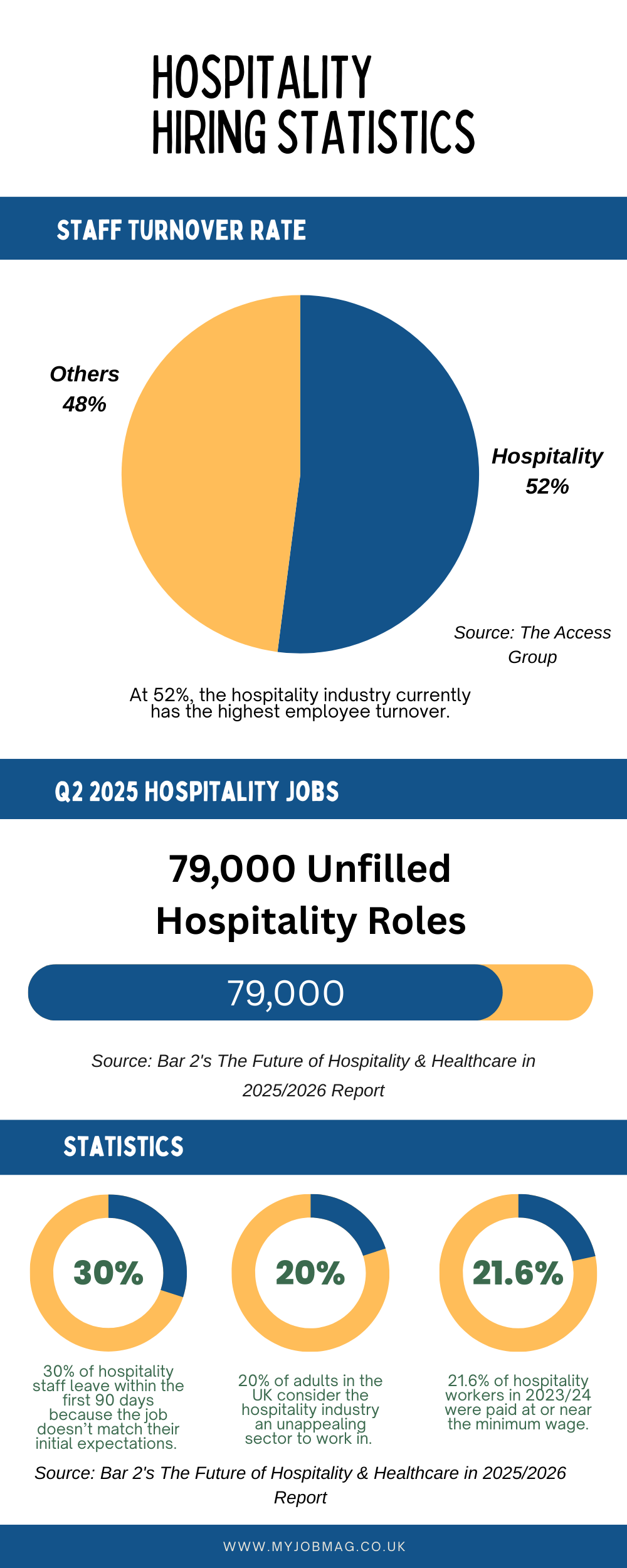
UK Hospitality Hiring Statistics
Now that we’ve seen where the funnel leaks, here’s how HR can fix it.
Include:
This improves search visibility and candidate relevance.
Mobile optimisation is critical for hospitality roles, where many candidates search and apply via phone.
Quick, automated pre-screening assessments can significantly reduce unqualified applications and save HR time.
Candidates lose interest fast. So the quicker you engage, the better the candidate experience and the higher your acceptance rates.
At every stage, set expectations and deliver on them. Silence breeds uncertainty.
Great onboarding reduces early turnover, improves productivity, and boosts employee satisfaction.
Here’s how some HR teams in hospitality we worked with are already tightening the funnel, according to reports from their internal HR reports:
Example A: Clear Job Descriptions with Pay Bands
When a mid-size restaurant group added clear hourly ranges and shift details to job ads, they saw:
Example B: Automated Candidate Updates
Another hotel chain implemented:
This reduced candidate drop-off before the interview stage by over 25%.
Here’s what a broken funnel really costs hospitality businesses:
Frequent hiring and training impact the bottom line. A single recruit can cost hundreds of pounds. Multiply that across dozens of hires each year, and you’re looking at a significant burden.
Unlike some industries, hospitality has:
This makes the hiring funnel both more complex and more fragile. A broken process has a much bigger impact here than in many corporate settings.
If there’s one idea HR teams should remember from this article, it’s this: Every vacancy is only as strong as the weakest stage in your recruitment funnel.
Fix the leaks, attract more talent, keep them engaged, and hire faster. That’s how HR professionals transform hiring from a reactive chore into a strategic advantage.
In a sector with tens of thousands of vacancies and continual churn, the difference between a broken and optimised hiring funnel is not subtle. It influences:
For HR teams in UK hospitality, optimising the recruitment funnel is not just best practice. It’s becoming business critical.

Hello, we are a team of experienced recruiters and we are happy to help you recruit your next team member.
07985672434
Leave a Comment