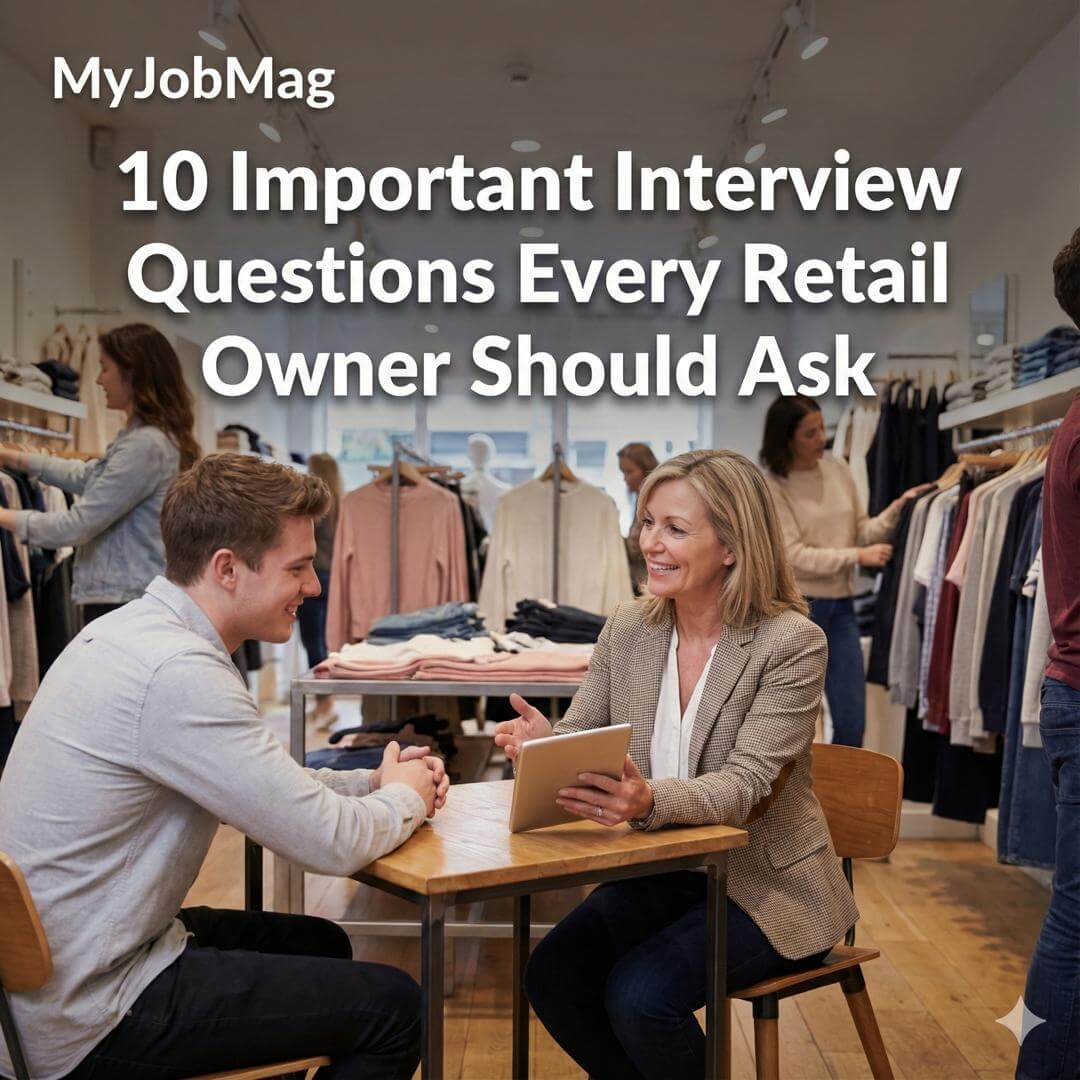
Hiring the right retail staff is one of the most important decisions you’ll ever make as a store owner. Whether you run a boutique, a supermarket, a convenience store, a fashion outlet, or a multi-location chain, the people you bring into your team directly influence customer experience, sales performance, and day-to-day store operations.
Yet retail hiring isn’t always straightforward. The persistent high employee turnover in the UK retail sector has made it difficult for retail owners to find reliable staff. Interviews are your best opportunity to solve this problem, but only if you ask the right questions.
This guide breaks down the 10 most important interview questions every retail owner should ask, what each question reveals, and how to interpret the answers so you can hire confidently and avoid costly mistakes. And to make your process even easier, we’ve added a free Retail Sales Assistant Interview Scorecard Template you can use immediately to score candidates and compare results fairly.
Retail is fast-paced, people-focused, and constantly changing. Because of this, good retail employees need:
A CV alone cannot help you measure these qualities. But the right interview questions can.
To make your hiring process even smoother, we've put together a free Retail Sales Assistant Interview Scorecard Template you can start using right away. This simple, ready-made sheet helps you score candidates objectively, compare interviews at a glance, and make faster, more confident hiring decisions. Get the template here and make a copy.
These 10 questions help you dig deeper, spot red flags early, and identify candidates who will represent your brand well, especially during busy seasons or high-pressure situations.
Why You Should Ask It: This is the cornerstone of any retail interview. It moves beyond the theoretical ("I'm good with people") and forces the candidate to prove it with a real-world example. It tests their initiative, empathy, and problem-solving skills in a customer-centric context.
What to Listen For:
Red flags:
Sample of a Great Answer:
"A customer came in looking for a specific brand of baby food we had discontinued. She was clearly stressed. Instead of just saying we didn't have it, I remembered a similar product from a new supplier. I grabbed a sample for her, showed her the ingredients to compare, and even looked up online reviews on my phone to put her at ease. She bought three jars and was so grateful she came back the following week to tell me her baby loved it."
Pro Tip:
A candidate who naturally uses words like “helped,” “resolved,” “listened,” or “supported” likely has strong service instincts. Also, if a candidate gives a weak or generic answer, follow up with: "Can you give me an example of a time you went above and beyond what was required for a customer?"
Why You Should Ask It: Every retail employee will face an upset customer. This question assesses their conflict resolution skills, emotional control, and loyalty to your brand under pressure. You need to know they can de-escalate a situation, not fuel the fire.
What to Listen For:
Red flags:
Sample of a Great Answer:
"A gentleman was furious because a sale item was out of stock. He felt we had false advertising. I listened without interrupting, apologized for the inconvenience, and explained that demand was higher than we anticipated. I then checked our inventory system, found the item at another location 10 minutes away, and called that store to put it on hold for him. I also gave him a 10% off coupon for his next purchase with us. He left calm and thanked me for my help."
Pro Tip: Beware of answers where the candidate "won" the argument. In retail, "winning" against a customer usually means losing a customer for life.
Why You Should Ask It: This situational question tests integrity, judgment, and understanding of protocol. Internal theft is a massive problem in retail, and you need employees who will protect your assets.
What to Listen For:
Red flags:
Sample of a Great Answer:
"My first step would be to immediately and discreetly find a manager to report exactly what I saw. I wouldn't confront my coworker, as that could escalate the situation or put me in an unsafe position. I would provide the manager with the facts, who I saw, what product it was, and when it happened, and let them handle it from there."
Practical Tip: There is only one right answer here. Any deviation, such as "I'd mind my own business" or "I'd confront them right there," is a major red flag.
Why You Should Ask It: Retail is synonymous with peaks of intense activity. This question assesses stamina, prioritisation, and a positive attitude during stressful times that are inevitable in your business.
What to Listen For:
Red flags:
Sample of a Great Answer:
“During our Black Friday sale, the line was out the door. I was on the register, and my goal was to be both fast and friendly. I made sure to make eye contact with each customer, give them a quick, genuine greeting, and process their transaction efficiently. During the 30-second lulls, I'd quickly straighten the impulse-buy items near my register. It was chaotic, but the energy was exciting, and our team worked together to get everyone through quickly."
Practical Tip: Ask for specifics about the environment. "How long was the line?" "How did you and your team communicate?" This reveals the depth of their experience.
Why You Should Ask It: This philosophical question reveals their core understanding of the retail role. It separates the transaction-processors from the brand ambassadors.
What to Listen For:
Red Flags:
Sample of a Great Answer:
"To me, excellent customer service isn't just about ringing a sale. It's about creating a connection. It's listening to what a customer is really looking for, even if they can't articulate it, and then using my product knowledge to find the perfect solution for them. It's making them feel heard, valued, and eager to come back."
Practical Tip: Follow up with, "And can you give me an example from your past where you put that philosophy into practice?" This links their theory to action.
Why You Should Ask It: Product knowledge is sales power. This question assesses their proactivity, learning style, and genuine interest in your specific store and its offerings.
What to Listen For:
Red Flags:
Lack of eagerness to explore your products.
Sample of a Great Answer:
"First, I'd dive into any training materials you provide. Then, I'd spend time on the floor physically handling the products and reading the packaging. I'd also ask my more experienced colleagues which products are most popular and what features customers ask about most often. Finally, I'd listen carefully to customer questions. That's typically the best way to learn what's important to know."
Practical Tip: For a specialised store (e.g., running shoes, cosmetics), you could bring a product to the interview and ask them how they would begin to learn about it to sell it effectively.
Why You Should Ask It: Retail is a team sport. From unloading trucks to setting up displays, success depends on collaboration. This question reveals if they are a team player or a lone wolf.
What to Listen For:
Red flags:
Sample of a Great Answer:
"At my last store, we had a huge task to reset the entire home goods section. I was assigned the kitchenware aisle. I made sure my section was done on time, but when I finished early, I asked the team lead who needed the most help and spent the last hour assisting another colleague with the heavier furniture items. We got the whole project done two hours ahead of schedule."
Practical Tip: Listen for humility. A red flag is someone who takes all the credit for a team's success.
Why You Should Ask It: This classic question is still vital. It helps you gauge career ambitions, longevity, and whether the candidate sees this job as a career or a temporary stopgap.
What to Listen For:
Red Flags:
“I haven’t given that a thought”
Sample of a Great Answer:
"I'm really passionate about retail management. In the next few years, I hope to have proven my value here and be developing the skills to move into an assistant manager position. I'm particularly interested in learning more about visual merchandising and inventory management."
Practical Tip: It's okay if their long-term goal is outside of retail (e.g., going back to school). What you want to hear is a commitment to being a reliable, valuable employee during their tenure with you.
Why You Should Ask It: This is a brilliant, low-cost way to measure genuine interest, work ethic, and resourcefulness. It shows whether they are proactively invested in getting this job at your store or just any job.
What to Listen For:
Red Flag
“I didn't really have to prepare for this interview because…”
Sample of a Great Answer:
"I came in yesterday and walked around the store to get a feel for the layout and your product range. I noticed you have a new line of eco-friendly cleaning supplies, which I think is a great addition. I also looked at your Google reviews to see what customers are saying. They consistently mention your staff's friendliness, which really attracted me. I have a few questions about your training process based on my visit."
Practical Tip: A candidate who has done zero preparation is telling you exactly how they will perform as an employee. Pay attention.
Why You Should Ask It: This is not a throwaway question. The quality of a candidate's questions is a direct window into their curiosity, critical thinking, and engagement.
What to Listen For:
Red Flags:
Practical Tip: Beware of candidates who have no questions. It often indicates a lack of genuine interest or critical thought. Also, be wary of questions that focus solely on breaks, discounts, and schedule, with no mention of the work itself.
Why You Should Ask It: Retail needs flexibility. Peak hours often fall outside the traditional 9–5.
Good answers:
Red flags:
Practical Tip: Document availability on the spot to avoid confusion later.
Get our Retail Sales Assistant Interview Scorecard Template here and make a copy.
Asking the right questions is only half of the process. You must evaluate answers correctly. Here’s how:
1. Look for real examples, not theory.
Good candidates can provide stories, not vague statements.
2. Focus on attitude over experience.
In retail, attitude is often a stronger predictor of success than skills.
3. Watch communication skills.
How clearly and confidently do they express themselves?
4. Observe body language.
Friendly, calm, and attentive behaviour is essential for customer-facing roles.
5. Test reliability.
Ask about punctuality, availability, and past work habits.
6. Consider cultural fit.
Will they fit well with your store’s values and environment?
Even if an interview starts well, some signs indicate a bad fit:
Lastly, trust your instincts. If something feels “off,” it usually is.
Asking these 10 questions will transform your interviews from simple conversations into powerful diagnostic tools. You will move beyond the surface and gain true insight into a candidate's character, capabilities, and fit for your unique retail environment.
Remember, the goal is not to find a perfect person, but to find the right person: one with integrity, a customer-first mindset, and the ability to thrive on your team. By listening carefully for the clues in their answers, you can make a confident hiring decision that will strengthen your store, please your customers, and build a retail team that drives your business forward.
The Retail Interview Scorecard Template tool helps you score each candidate objectively and compare them at a glance. Get it here and make your copy.

Hello, we are a team of experienced recruiters and we are happy to help you recruit your next team member.
07985672434
Leave a Comment