The trend for UK retail in 2026 is one of contraction. The industry is shrinking in terms of total headcount and physical footprint, yet paradoxically, the battle for talent remains fierce for the roles that remain.
For Human Resources professionals, the days of volume hiring are over. The industry has entered an era of "precision workforce planning," where high operational costs (driven by a record National Living Wage increase) collide with the rapid, tangible integration of Agentic AI.
The data for early 2026 paints a clear picture: the sector is shrinking in headcount but growing in skill requirements. To help you navigate this shifting landscape, we have curated the essential staffing statistics you need to know, sourced from the industry's most authoritative bodies, including the British Retail Consortium (BRC), the Office for National Statistics (ONS), PwC and the CIPD.
Retention and engagement of a leaner workforce
Total employment cost modelling (wages, NI, compression effects)
Reskilling for tech-enabled frontline roles
Ethical restructuring of redundant back-office functions
Adoption of AI tools within HR itself
The role of HR has evolved from recruiter to strategic workforce architect, balancing cost containment with skill transformation in a shrinking but more specialised retail labour market.
The fastest metric for any HR leader to grasp is the sheer scale of the workforce contraction. Following a challenging 2025, the retail sector has hit what the BRC describes as a "record low" in total employment.
As of the latest reports leading into 2026, the retail industry remains the UK's largest private-sector employer, but its dominance is waning. The most glaring realisation for HR professionals in 2026 is that the retail workforce is smaller than it has been in decades. The "golden era" of mass retail employment is seemingly over, replaced by a leaner, more technology-dependent model.
According to recent data from the British Retail Consortium (BRC), total retail jobs stood at 2.8 million leading into 2026. While still vast, this figure represents a significant downward trend. The BRC’s analysis highlights a troubling trajectory, noting an annual loss of 74,000 fewer jobs year-on-year.
Helen Dickinson, Chief Executive of the BRC, has described the current state of the industry employment as being at a "record low."
Insight for HR: This contraction is not accidental. It is structural. Retailers are not just failing to replace leavers; they are actively removing roles to protect margins. Your retention strategy for the remaining 2.8 million staff must be ironclad, as these survivors are likely carrying a heavier workload.
Historically, retail was a sector of high churn and high vacancies. In 2026, that narrative has flipped.
This statistic is critical for HR leaders. It suggests that while headcount is being reduced due to cost pressures (due to the increase in National Living Wage, which will be discussed in subsequent headings), the remaining roles are becoming harder to fill. This is likely due to a combination of factors: former retail workers leaving the sector entirely for better conditions in logistics or hospitality, and the increasing skill demands placed on shop-floor staff who are now expected to be tech-enabled customer service experts rather than just cashiers.
Notwithstanding, the bottom line is: If 63% of your competitors are struggling to hire, your employer value proposition (EVP) needs to be sharper than ever.
In 2026, the primary driver of workforce strategy is cost containment. HR directors are under immense pressure from the C-suite to justify every headcount, as legislative changes have increased the cost of employing staff.
The National Living Wage (NLW) is now set at £12.71 per hour for workers aged 21 and over. While beneficial for lower-paid workers during a cost-of-living crisis, this represents a substantial increase in the wage bill for retailers, particularly those with large shop-floor workforces.
This mandatory increase has a concertina effect up the pay scale. Differentials between entry-level staff, supervisors, and junior managers are being squeezed, forcing HR to raise salaries across the board to maintain a logical pay structure, further inflating costs.
The CIPD Labour Market Outlook notes a median basic pay increase expectation of 3% across the economy. However, for many retailers, the mandatory NLW increase means their actual wage bill growth is running significantly higher than this median, eroding already thin margins.
Announced in November 2025, the new rates represent a substantial hike aimed at maintaining the "two-thirds of median earnings" target.
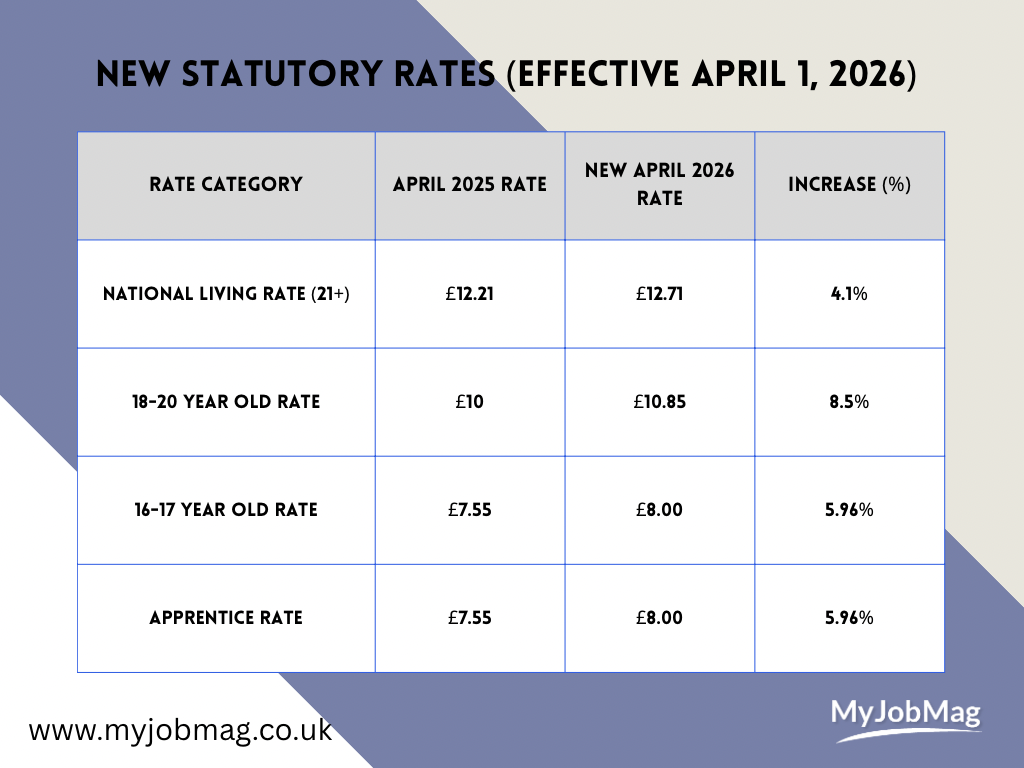
(Source: Gov.uk / Low Pay Commission)
It is not just wages that are squeezing budgets. The broader economic environment in 2026 is forcing a rethink of workforce size.
According to PwC’s 2026 Retail Outlook, retailers are facing intense pressure from non-wage costs, including rises in employer National Insurance contributions and business rates for larger premises.
PwC’s analysis indicates a strategic shift where retailers are aggressively trying to protect margins by reallocating costs. The traditional retail model of high-headcount stores is becoming financially unsustainable for many brands in the face of these cumulative fixed costs. For HR, this means that every request for a new hire must be weighed against the potential for automation or process redesign.
Furthermore, the Centre for Retail Research has predicted a grim outlook for the inevitable outcome of these pressures, forecasting upwards of 200,000+ redundancies by the end of the current economic cycle, as high street giants and smaller chains alike restructure to survive.
If cost is the push factor for workforce change, Artificial Intelligence is the pull factor. 2026 is widely regarded as the "watershed" year where AI moved from being a buzzword to a genuine substitute for human labour in retail.
HR professionals must be realistic about the impact of generative and analytical AI on job numbers. We are moving past the stage where technology only augments human roles. It is now actively replacing them, particularly in administrative functions.
The CIPD Labour Market Outlook (Autumn/Winter 2025-26) provides sobering data on this trend. Their survey reveals that roughly 17% of employers expect AI and automation technologies to lead to a reduction in their total headcount over the next 12 months.
In retail, this is not largely hitting the shop floor yet (although self-checkout utilisation is at an all-time high), but rather the corporate head office and back-office support functions. Roles in data entry, basic HR administration, payroll processing, and junior merchandising are increasingly being automated.
Insight for HR: HR leaders should lead the "Reskilling Revolution." If 17% of administrative roles are at risk, can those employees be retrained for customer-facing or data-management roles? The alternative is a costly cycle of redundancy and recruitment.
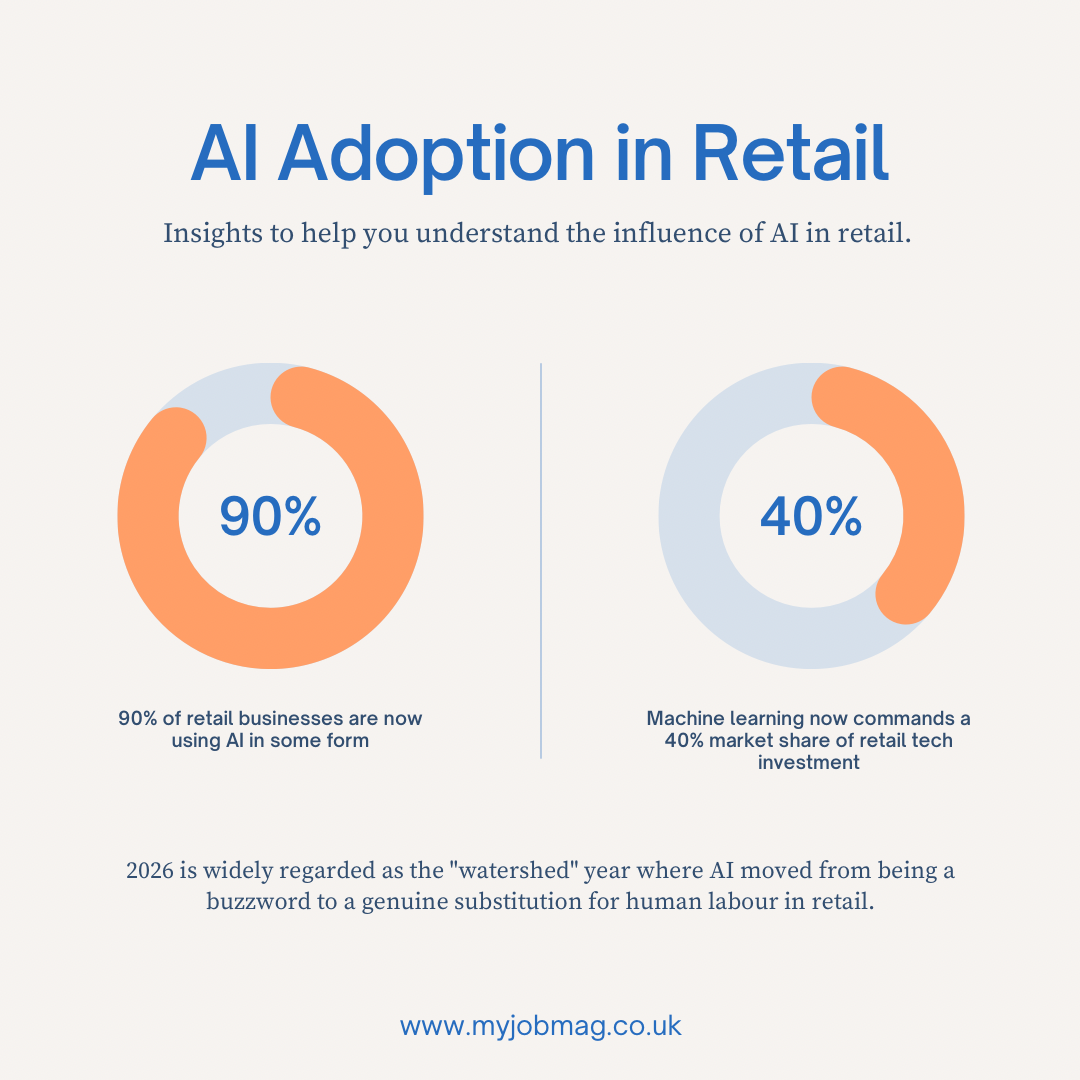
Agentic AI Adoption in Retail
The adoption of AI is driving a fundamental restructuring of retail expenditure. PwC’s Retail Outlook 2026 highlights a crucial trend: retailers are striving to shift costs from "back-office" functions toward "customer-facing" activities.
By using what PwC terms "agentic AI" to handle complex supply chain forecasting, inventory management, and administrative tasks, retailers hope to free up budget. The strategic intent is to reinvest some of these savings into better-paid, higher-skilled frontline roles focused on experiential retail (the one area where physical stores can still compete with pure-play e-commerce).
For HR, this necessitates a massive reskilling agenda. The retail workforce needs fewer spreadsheet administrators and more brand ambassadors with high emotional intelligence and technological fluency. The challenge for HR is managing the redundancy processes for legacy roles ethically while simultaneously building pipelines for these new, hybrid skills profiles.
The combination of high costs and technological integration is changing how retailers hire, not just who they hire. The reliance on flexible, seasonal labour is shifting towards a desire for a leaner, more permanent core workforce.
For decades, the retail staffing model relied heavily on flexing up with temporary staff during peaks (Christmas, Black Friday) and flexing down afterwards. 2026 data suggest this model is fracturing.
The KPMG and REC Report on Jobs (Feb 2026) noted that the retail sector recorded one of the steepest falls in temporary job opportunities at the start of the year.
Why the shift? Facing high recruitment costs and the administrative burden of onboarding temp staff, retailers are choosing to run leaner operations year-round, utilising AI for better demand forecasting to manage peaks with existing permanent staff. This puts pressure on HR to ensure current staff are cross-trained, and contracts allow for necessary flexibility.
Finally, the geography of retail jobs continues to change. The "death of the high street" narrative has evolved into a subtle reality of winners and losers based on location.
While the World Socialist Web Site notes that the first days of 2026 saw major chains announcing restructures threatening thousands of high-street positions, other areas remain resilient. Data from real estate analysts CBRE indicates that Retail Parks continue to outperform high streets, maintaining lower vacancy rates.
HR strategies must therefore be hyper-localised. A recruitment strategy that works for a flagship store in a thriving out-of-town retail park will likely fail for a struggling high street branch. HR must use local labour market data to adjust wages and benefits accordingly, rather than relying on national blanket policies.
The staffing statistics for UK retail in 2026 paint a picture of an industry in the midst of a painful, necessary change. The data points: 74,000 fewer jobs annually, a 63% recruitment difficulty rate, and 17% of employers planning AI-driven headcount reductions, are not just numbers. They are the parameters within which HR must operate.
The era of abundance in retail staffing is over. The successful HR professional in 2026 is not a "reactive recruiter" but a "strategic workforce architect."
To succeed in this environment, HR needs to move beyond traditional metrics. You need to:
By anchoring your people strategy in these 2026 statistics, you can move from reactive crisis management to proactive workforce architecture.

Hello, we are a team of experienced recruiters and we are happy to help you recruit your next team member.
07985672434
Leave a Comment