Navigating the UK retail recruitment landscape requires more than just a well-written job description; it demands a hyper-local understanding of compensation. As staffing challenges continue to evolve and candidate expectations shift, relying on a single, national average salary is no longer an effective strategy for attracting top talent.
For recruitment and HR professionals, localised data is the key to building competitive, sustainable, and legally compliant compensation packages. A retail sales associate in central London faces vastly different living costs and has vastly different salary expectations compared to a store manager in Glasgow or a merchandising supervisor in Birmingham.
This comprehensive guide breaks down the average salaries for retail jobs across major UK cities. It explores the verified statistics shaping the market, uncovers why regional variations exist, and provides practical insights to help you optimise your recruitment strategy without unnecessarily inflating your payroll budget.
Before diving into specific cities, it is essential to understand the national baseline. The retail sector is one of the UK’s largest employers, offering a massive spectrum of roles from entry-level cashiers to regional directors.
Nationally, the average salary for a retail worker in the UK typically falls at £29,260 annually, depending heavily on the role, region, inclusion of commission, experience level and the specific sub-sector (e.g., luxury goods versus grocery).
It is also impossible to discuss retail salaries without mentioning statutory requirements. The UK’s National Living Wage (NLW) sets the absolute floor for retail compensation. Retail HR professionals must constantly monitor these legal thresholds, as incremental increases to the NLW often create a "ripple effect," pushing up the salary expectations for supervisors and store managers to maintain fair pay differentials.
To build a truly effective hiring strategy, however, we must look beyond the national average and analyse the localised data.
Several factors determine how much retail workers earn.
Cities with higher living costs pay more. Examples of citizens with higher living costs include:
Retailers adjust wages to remain competitive.
Large chains often offer:
Examples include:
Retail salaries rise with experience. Typical progression:
Each level adds significant pay increases.
Some retail sectors include commissions:
Commission structures can significantly increase income.
Retail managers often earn bonuses based on:
High-performing stores offer better earnings.
Retail wages are evolving due to several trends, such as:
Government policy continues to push wages higher. Higher minimum wages mean retail employers must increase pay.
Retailers are currently facing ongoing staffing challenges. To attract workers, companies are raising wages.
Major chains are competing aggressively for talent. Some supermarkets now offer hourly wages above the national minimum wage to remain competitive.
Interesting Read: Employment Laws Every UK HR Professional Should Know
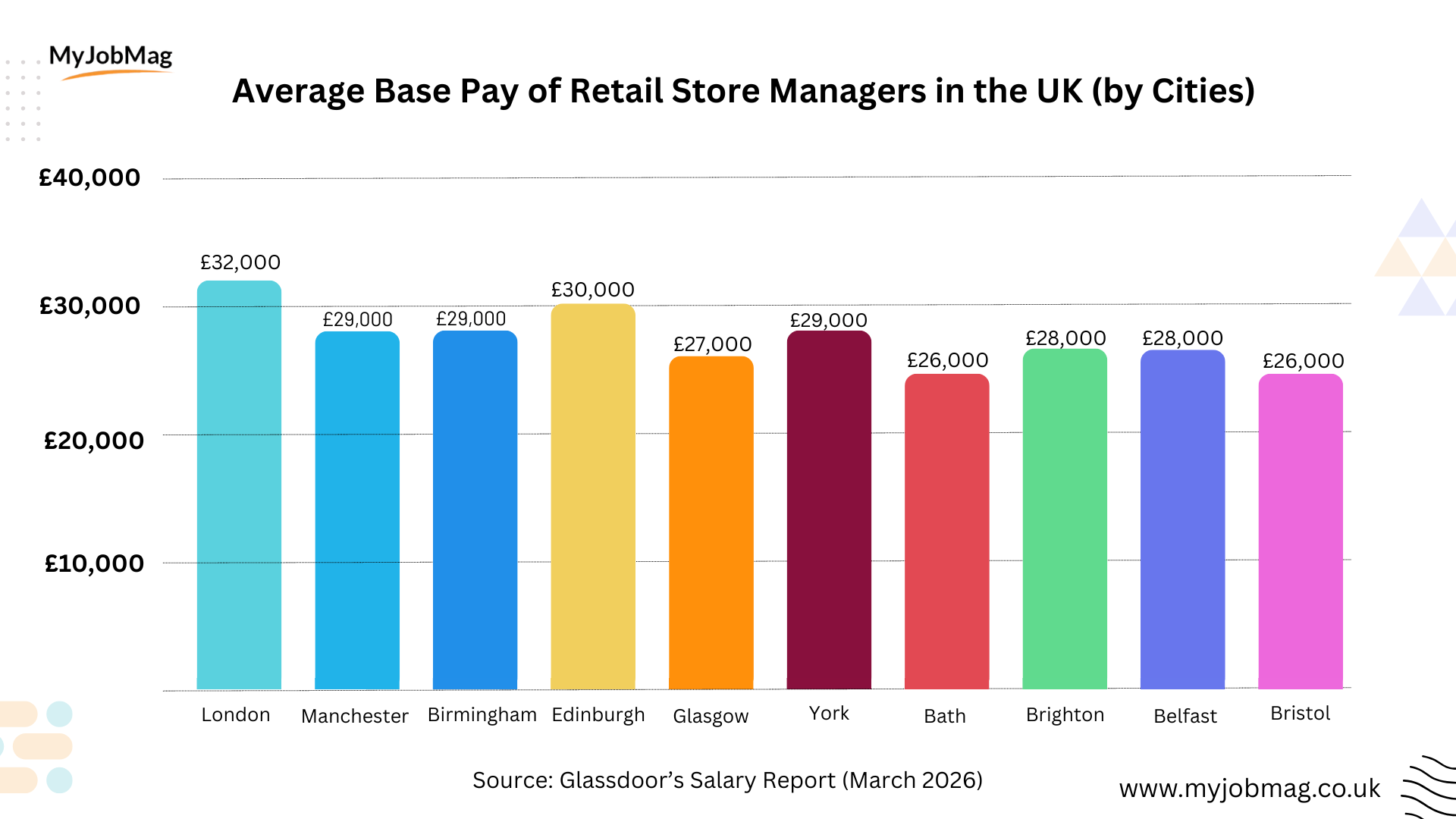
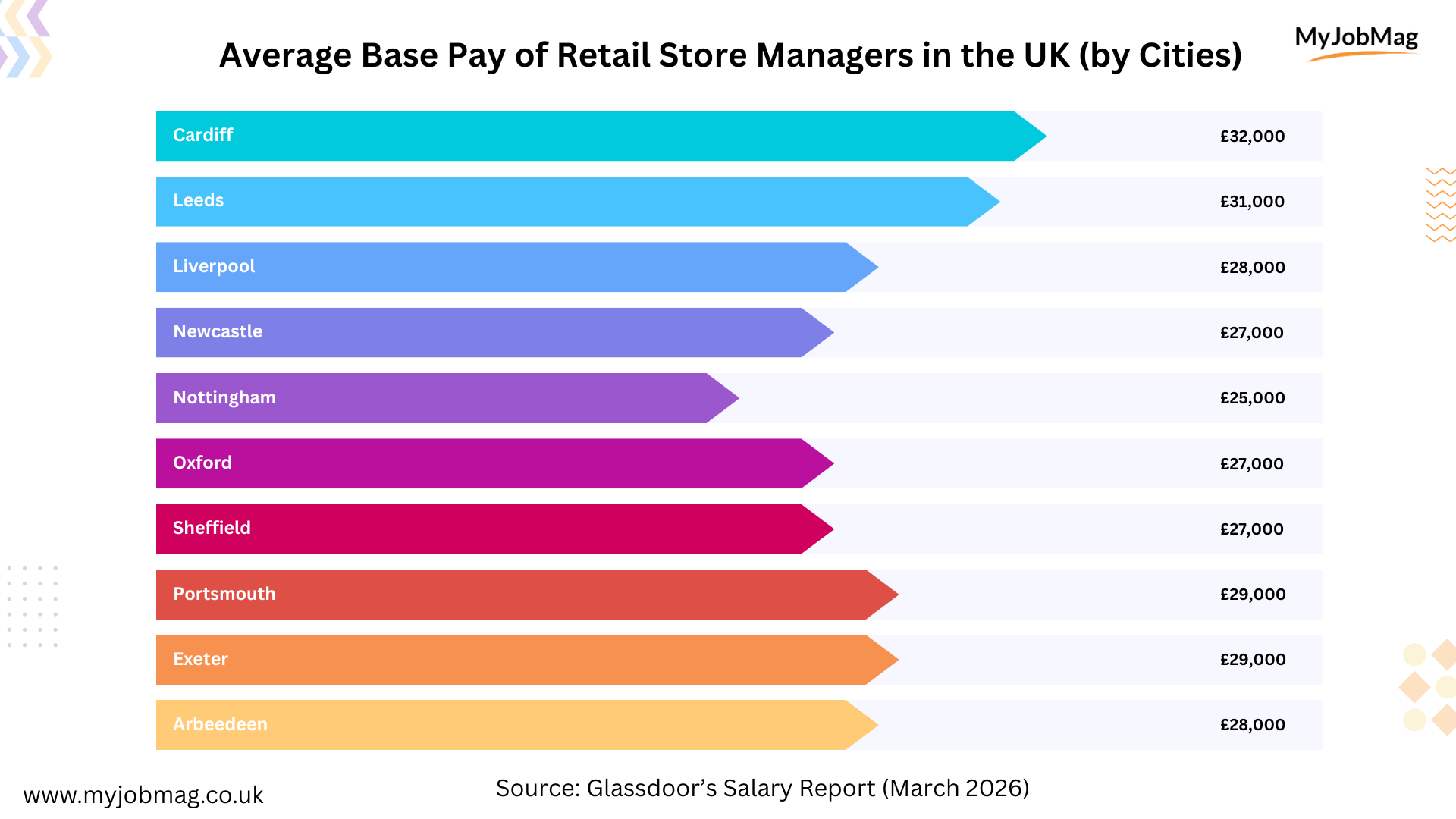
The table below provides a rundown of the major cities in the UK and the average base salary of a retail sales associate and a retail store manager.
| City | Average Base Pay of a Retail Sales Associate | Average Base Pay of a Retail Store Manager |
| Arbedeen | £20,000 | £28,000 |
| Bath | £20,000 | £26,000 |
| Belfast | £20,000 | £28,000 |
| Brighton | £19,000 | £28,000 |
| Birmingham | £19,000 | £29,000 |
| Bristol | £20,000 | £26,000 |
| Cambridge | £20,000 | £32,000 |
| Cardiff | £20,000 | £32,000 |
| Durham | £21,000 | £29,000 |
| Edinburgh | £20,000 | £30,000 |
| Exeter | £20,000 | £29,000 |
| Glasgow | £19,000 | £27,000 |
| Leeds | £19,000 | £31,000 |
| Liverpool | £19,000 | £28,000 |
| London | £21,000 | £32,000 |
| Manchester | £19,000 | £28,000 |
| Newcastle | £19,000 | £27,000 |
| Norwich | £19,000 | £30,000 |
| Nottingham | £19,000 | £25,000 |
| Oxford | £20,000 | £27,000 |
| Portsmouth | £19,000 | £29,000 |
| Sheffield | £19,000 | £27,000 |
| York | £19,000 | £29,000 |
Source: Glassdoor UK
The breakdown below highlights the average earnings for retail roles across major UK economic hubs. We got our data from Glassdoor’s Salary Report (March 2026).
Note: The salary for managers working for large chains is likely to be higher than the figures provided here. Also, the figures here only represent the base pay. Additional payments like bonuses, commissions, and overtime may be included in the total pay package.
London is the undisputed epicentre of UK retail, home to global flagship stores on Oxford Street and massive retail hubs like Westfield. However, the capital's notoriously high cost of living means salaries here must carry a "London Weighting" to remain competitive.
When recruiting in London, base salary is heavily scrutinised by candidates. If your budget cannot stretch to the top end of the London average, you must aggressively market your commission structures, travel subsidies (like season ticket loans), and guaranteed progression timelines.
Manchester boasts a thriving retail scene, anchored by the Arndale Centre and the Trafford Centre. The city has seen significant economic growth, making it a highly competitive market for retail talent, though it remains more cost-effective for employers than London.
Manchester has a massive student population due to its universities. Retail HR teams can capitalise on this by offering highly flexible, part-time contracts that appeal to students, reducing the need to compete solely on full-time base salaries.
As the second-largest city in the UK, Birmingham's retail landscape is dominated by the Bullring and Grand Central. The talent pool here is vast, but so is the competition among major retail brands.
Because average salaries in Birmingham track closer to the national median, retail employers can stand out by focusing heavily on employer branding. Highlighting a positive store culture, mental health support, and predictable shift patterns can win over candidates who are weighing identical financial offers from competitors.
Edinburgh features a unique retail environment. With its high volume of international tourism and areas like Princes Street and Multrees Walk, there is a distinct lean toward premium, luxury, and heritage retail.
Edinburgh’s retail sector heavily values candidates with multi-lingual skills and experience in premium customer service because the city is a major international tourist destination, drawing millions of overseas visitors annually who expect high-quality, personalised service. If you are hiring for a luxury boutique in Edinburgh, standard retail pay will not suffice; your compensation packages must reflect the specialised skill set required to serve a high-net-worth tourist demographic.
Glasgow is widely recognised as one of the best shopping destinations in the UK outside of London, driven by the famous "Style Mile" (Buchanan Street, Argyle Street, and Sauchiehall Street). It is a high-footfall, fast-paced retail environment.
Glasgow's retail environment is highly fast-paced. When drafting recruitment content here, focus on the energy of the team and the opportunity for fast-tracked management training. The data suggests Glasgow pays competitively, meaning retention strategies must be sharp to prevent staff from jumping to a neighbouring store on Buchanan Street for a minor pay bump.
York’s historic streets draw massive footfall, making retail a competitive space for hiring. While the cost of living is rising, local businesses often have to compete with high-street giants for top talent.
Because York has a mix of boutique and corporate retail, emphasising career progression and flexible weekend rotas can help you win over candidates who might otherwise jump ship for slightly higher hourly rates.
Bath is a premium shopping destination. The high cost of living here means candidates actively look for robust compensation packages, putting pressure on retail HRs to offer more than just the statutory minimums.
To stand out in Bath, consider offering travel subsidies. Commuting into the city centre can be expensive, and covering part of that cost is a massive green flag for applicants.
Read Also: 10 Tips for Building a Successful Career as an HR Professional in Retail
Brighton’s vibrant, eclectic retail scene means you are often hiring for culture and personality just as much as experience.
Employee retention in Brighton often hinges on workplace culture. Focus your job descriptions on diversity, inclusivity, and any community-driven initiatives your store participates in.
Belfast offers a more affordable cost of living compared to mainland UK cities, but retail remains one of its most vital employment sectors.
There is a noticeable bump in pay for management roles here. If you are struggling to hire entry-level floor staff, building a clear, fast-tracked "Associate to Supervisor" pipeline will boost your application rates.
As a major economic hub in the South West, Bristol's retail sector is booming. The talent pool is large, but so is the competition among employers.
Bristol has a highly environmentally conscious demographic. Highlighting your brand’s sustainability practices in recruitment marketing is a proven way to attract local retail talent.
Average Base Pay of Retail Store Managers in the UK
The Welsh capital features massive shopping centres like St David's, creating a high-volume hiring environment for retail HR teams.
Volume hiring is the name of the game here. Streamline your interview process. If your hiring pipeline takes longer than two weeks, candidates will simply walk over to the next store in the mall.
Leeds is an absolute powerhouse for retail in the North. It’s a shopper’s paradise, which means staff turnover can be a headache if your compensation isn't competitive.
With a large student population, offering flexible, part-time shifts tailored around university schedules will guarantee a steady stream of enthusiastic seasonal and weekend staff.
Liverpool’s retail environment, anchored by Liverpool ONE, is heavily customer-service driven. The city is known for its friendly locals, and stores hire specifically for that welcoming charm.
When writing job ads for Liverpool, ditch the overly corporate jargon. Keep the tone conversational, warm, and focused on teamwork and customer interaction.
Newcastle boasts a concentrated, bustling city centre. Retail salaries here are slightly lower than the national average, aligning with the regional cost of living.
Because base salaries are relatively uniform across the city, you can win top talent by offering superior staff discounts or early access to sales.
Nottingham has a balanced retail economy, blending large department stores with independent boutiques, creating a diverse talent pool.
Ensure your budget reflects the local premium in Nottingham to avoid high turnover.
Oxford’s extreme cost of living heavily impacts the retail labour market. Candidates simply cannot afford to take low-paying jobs here.
Be entirely transparent about your salary bands in your job postings. In an expensive city like Oxford, candidates will skip applications that say "competitive salary" and apply to the ones that show the actual numbers.
Sheffield offers a stable, reliable retail market with a strong focus on community and loyalty.
Sheffield employees value job security and strong management. Emphasise your company’s internal training programs and long-term stability in your recruitment materials.
With its unique blend of high-street shops and the popular Gunwharf Quays outlet, Portsmouth requires retail staff who can handle high-paced, tourist-heavy seasons.
Highlight seasonal bonuses or performance-based incentives. Outlet mall environments move fast, and staff are highly motivated by visible financial rewards for hitting targets.
Exeter is a growing retail hub in the South West. While smaller than Bristol, it attracts premium brands and a discerning shopper base.
Emphasise work-life balance. Exeter is known for its excellent quality of life, and offering guaranteed consecutive days off can be a major selling point for retail managers, avoiding burnout.
Aberdeen’s economy, historically tied to the energy sector, means that general wages (and the cost of living) have traditionally been higher here than in other Scottish cities.
You are competing with administrative and entry-level corporate roles that pay well. Focus on the dynamic, non-desk-bound nature of retail work to appeal to candidates looking for an active, customer-facing career.
Average Base Pay of Retail Store Managers in the UK
A smaller, historic university city, Durham has a tight-knit retail community where reputation matters.
Leverage employee referral programs. In a smaller city where many retail workers know each other, a good referral bonus is often your cheapest and most effective recruitment tool.
Norwich is largely isolated from other major cities, meaning it retains its retail talent well, provided the working environment is positive.
Since the talent pool doesn't commute in from neighbouring cities, focus heavily on retaining the staff you have. Regular check-ins and cross-training keep the local team engaged.
Like Oxford, Cambridge has an incredibly high cost of living driven by the university and the booming tech sector.
Offer lifestyle perks. If you can't push your base salary any higher, partner with local businesses (gyms, cafes, tech repair) to offer exclusive discounts that functionally lower your employees' living costs.
Interesting Read: How to fill a Retail Job Vacancy in 72 Hours, even on a Budget
Entry-Level Retail Salaries
Entry-level retail jobs typically include:
Typical base pay:
These roles focus heavily on:
Mid-Level Retail Salaries
Mid-level roles include:
Typical salaries:
Responsibilities include:
Retail Management Salaries
Management roles offer higher compensation.
Typical roles include:
For example:
Responsibilities include:
If your organisation cannot offer the top-tier salaries in a given city, how do you attract and retain reliable retail staff? The answer lies in the Total Rewards Package. Modern candidates look at the holistic value of an employer.
Here are actionable strategies you can implement to strengthen your retail recruitment campaigns across the UK:
Burnout and unpredictable rotas are the primary drivers of retail staff turnover. While you might need staff for weekends and evenings, providing rotas three to four weeks in advance is a massive competitive advantage. Give your staff the ability to swap shifts easily via mobile apps. A candidate will often accept a slightly lower hourly rate in exchange for a schedule that respects their personal life and family commitments.
Retailers have a unique advantage: their own inventory. A generous staff discount (e.g., 30% to 50% off) is a tangible financial benefit. When advertising roles, calculate the average annual savings a typical employee makes using their discount and feature that number prominently in your job ads as part of the "Total Value" of the role.
Many candidates take entry-level retail jobs as a stopgap because they do not see a future in them. Change this narrative by explicitly mapping out progression during the interview stage. Show them the exact milestones required to move from Sales Associate to Supervisor, and from Supervisor to Assistant Store Manager. Highlighting internal promotion statistics (e.g., "70% of our Store Managers started on the shop floor") is incredibly persuasive.
The cost-of-living crisis is a heavy burden for many retail workers. Forward-thinking HR teams are implementing financial well-being tools, such as Earned Wage Access (EWA) apps, which allow employees to draw down a portion of their earned wages before payday. Offering this kind of practical financial flexibility can significantly boost your applicant conversion rates.
Never use a generic template for a nationwide rollout. If you are hiring in London, mention the proximity to specific Tube stations. If you are hiring in Manchester, mention the vibrant team culture. Tailor the tone and the benefits to the specific city's demographics. Localised ads always perform better in search engine algorithms and resonate more deeply with candidates.
Understanding the average salary for retail jobs across the UK is the foundation of a successful hiring strategy. However, the numbers only tell half the story. By analysing local market conditions, understanding the nuances between base pay and commission, and leveraging non-financial benefits like flexible scheduling and clear career progression, you can build compelling offers that attract dedicated, high-performing retail staff. The most successful retailers in 2026 are those who treat their compensation strategy not as a static spreadsheet, but as a dynamic tool for talent acquisition.

Hello, we are a team of experienced recruiters and we are happy to help you recruit your next team member.
07985672434
Leave a Comment