If you are an HR professional or hiring manager in the UK hospitality sector, you know that a bad hire is not just an administrative headache, but also a financial and operational drain. When the wrong person is placed on a busy Friday night shift, the ripple effects are immediate: existing staff take on the burden, customer service standards slip, and team morale plummets.
The stakes are incredibly high. According to the Chartered Institute of Personnel and Development (CIPD), the UK hospitality sector faces a staggering average employee turnover rate of 52%, compared to the national average of just 34% across other industries.
While external factors like the cost of living and shifting workforce demographics play a role, a massive portion of this turnover stems from a single root cause: misalignment at the interview stage.
For too long, the hospitality industry has relied on rushed interviews, gut feelings, and outdated questions like, "What is your biggest weakness?" or "Where do you see yourself in five years?" In 2026, these cliché questions no longer yield the insights you need.
To hire staff who will stay, thrive, and elevate your guest experience, you need to change the way you interview. This guide breaks down the right questions to ask, the psychology behind them, and how to spot the true hospitality professionals among your applicant pool.
Key Takeaways
- A bad hire in hospitality is instantly expensive. With turnover in the sector sitting at 52% (Chartered Institute of Personnel and Development), misalignment at the interview stage is not a small mistake, but a recurring operational cost.
- Shift from interrogation to conversation. The best hospitality professionals are natural communicators. Design interviews that reveal personality, empathy, and composure, not rehearsed textbook answers.
- Hire for EQ, train for skill. Technical abilities can be taught quickly. Emotional intelligence, resilience under pressure, and coachability are long-term predictors of performance and retention.
- Use behavioural and situational questions strategically. Past behaviour predicts future behaviour. Structure evaluations around the STAR method to move beyond vague claims and uncover real competence.
- Tailor questions to the role.
- Front-of-House: Test empathy, anticipation, and grace under pressure.
- Back-of-House: Assess communication, reliability, and calm problem-solving.
- Management: Probe for culture-building ability, cost control awareness, and conflict resolution skills.
- Listen for patterns, not just answers. Ownership over blame. “We” over “I.” Curiosity over indifference. Self-awareness over defensiveness.
- Stop interviewing. Start auditioning. Hospitality is a live performance. When you treat interviews like auditions for teamwork, composure, and guest-centric thinking, you dramatically increase your chances of hiring people who stay, thrive, and elevate your brand.
A Shift From Interrogation to Conversation
The best hospitality professionals, whether they are Michelin-starred chefs or brilliant local bartenders, are natural conversationalists. If your interview process feels like a rigid police interrogation, you will stifle the exact personality traits you are trying to uncover.
Your goal is to assess three core pillars:
- Emotional Intelligence (EQ): Can they read a room and empathise with guests and colleagues?
- Resilience: How do they handle the inevitable chaos of a busy service?
- Coachability: Are they open to feedback and willing to learn your specific brand standards?
HR Advice: Technical skills, like how to carry three plates or operate your specific POS system, can be taught in a week. Empathy, resilience, and a positive attitude cannot. Hire for EQ and train for IQ.
The Core Framework of Hospitality Interviews: Behavioral vs. Situational
To get past rehearsed answers, you need to use behavioural and situational questions.
- Behavioural questions ask candidates to reflect on past experiences ("Tell me about a time..."). Past behaviour is the best predictor of future behaviour.
- Situational questions present a hypothetical scenario relevant to your business ("What would you do if...").
To evaluate their answers effectively, train your hiring managers to listen for the STAR Method.
When a candidate answers a behavioural question, they should ideally outline:
- S - Situation: The context of the story.
- T - Task: Their specific role or responsibility in that situation.
- A - Action: The actual steps they took to resolve the issue.
- R - Result: The final outcome (and what they learned).
What are the Right Questions to Ask During a Hospitality Recruitment Interview?
Below, we’ve provided a breakdown of the right questions to ask based on the role you’re hiring for.
1. Front-of-House (FOH) Questions: Assessing Empathy and Grace Under Fire
Front-of-house staff (Waitstaff, Bartenders, Hosts, and Receptionists) are the face of your business. They need to manage guest expectations, juggle multiple tasks, and maintain a calm exterior even when the kitchen is backed up.
Q: "Tell me about a time you had to deliver bad news to a guest (e.g., an 86'd menu item, a lost reservation, or a delayed room). How did you handle it?"
- Why ask this: Mistakes happen in hospitality. You are looking for a candidate who takes ownership rather than blaming the kitchen or the booking system.
- What to listen for: Do they lead with a genuine apology? Do they immediately offer a solution or alternative?
Q: "Walk me through a scenario where you had a table or guest who was visibly unhappy, but they wouldn't explicitly tell you what was wrong. What did you do?"
- Why ask this: This is a pure emotional intelligence test. Great service is anticipatory.
- What to listen for: Look for candidates who talk about reading body language (e.g., pushed away plates, looking around the room) and how they gently broached the subject with the guest to turn the experience around before the guest left a bad review.
Q: "Describe a shift where everything seemed to go wrong. How did you prioritise your tasks, and how did you feel at the end of the day?"
- Why ask this: Hospitality is stressful. You want to see how they manage their "weeds" (being overwhelmed).
- What to listen for: The best candidates will mention communicating with their team, asking for help, and taking things one step at a time. If they say, "I just ran faster," that is a recipe for eventual burnout.
2. Back-of-House (BOH) Questions: Assessing Consistency, Safety, and Teamwork
Chefs, line cooks, and kitchen porters work in high-pressure, high-temperature environments. The focus here shifts from guest-facing charm to reliability, communication, and crisis management.
Q: "Tell me about a time when communication broke down on the line during a busy service. What did you do to help reset the kitchen?"
- Why ask this: Kitchens run on clear, concise communication. When the printer is spitting out endless tickets, silence is deadly.
- What to listen for: You want a team player who stepped up to call the checks, slowed down the pace momentarily to get everyone on the same page, or helped a struggling section without being asked.
Q: "If you are prepping for a busy Friday night and you realise a delivery of a key ingredient is short, what is your immediate course of action?"
- Why ask this: Tests problem-solving and proactive thinking.
- What to listen for: Do they immediately inform the Head Chef or FOH manager? Do they suggest an alternative dish or a way to stretch the ingredient safely? You are looking for solutions, not panic.
Q: "How do you handle receiving critical feedback from a Head Chef or Expediter during the middle of a rush?"
- Why ask this: Tempers can flare in a kitchen. You need staff who can separate constructive, urgent feedback from personal attacks.
- What to listen for: A good answer highlights leaving ego at the door, making the immediate correction to get the food out, and discussing the issue calmly after service if necessary.
3. Management & Leadership Questions to Assess Retention and Business Acumen
When hiring General Managers, Head Chefs, or Supervisors, the focus must shift to their ability to build culture and protect your bottom line. Bad managers are the primary reason good staff leave.
Q: "Hospitality has a notoriously high burnout rate. Tell me about a time you noticed a team member struggling with burnout, and what specific steps you took to support them."
- Why ask this: Empathy in leadership is no longer optional; it is a retention strategy.
- What to listen for: Look for managers who talk about adjusting rotas, having one-on-one check-ins, offering mental health days, or redistributing workloads. Avoid candidates who view burnout as a "weakness."
Q: "Can you walk me through a time when you successfully reduced a major operational cost (like food waste, labour variance, or breakages) without compromising the guest experience?"
- Why ask this: Great managers understand that top-line revenue means nothing if the bottom line is leaking.
- What to listen for: You want specific metrics. "I noticed we were over-prepping garnish, so I adjusted the par levels and saved 5% on our weekly food cost."
Q: "Tell me about a time you had to manage a conflict between the Front-of-House and Back-of-House teams."
- Why ask this: The FOH vs. BOH divide is a classic hospitality trope that destroys team cohesion.
- What to listen for: The ideal candidate acts as a bridge, not a barrier. They should describe bringing both sides together to understand each other's pressures, rather than taking sides.
Spotting the Green and Red Flags of Hospitality Interviews
During the interview, the way a candidate answers is often just as revealing as the answer itself.
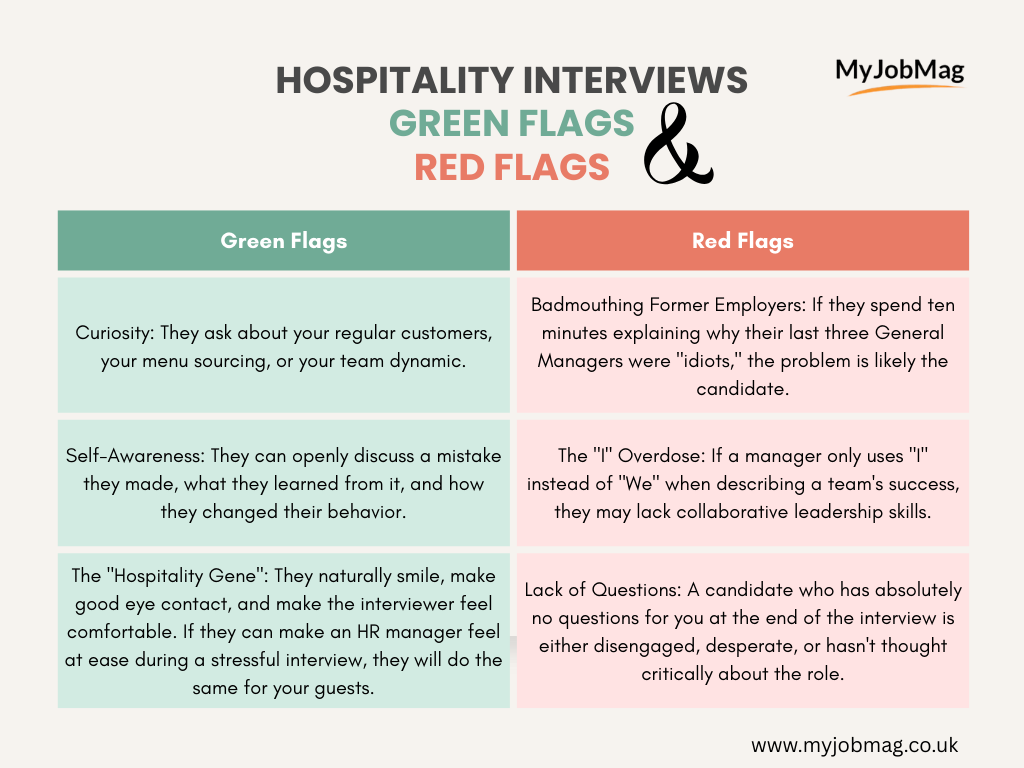
Hospitality Interviews: Green Flags and Red Flags
Final Thoughts: Stop Interviewing, Start Auditioning
The hospitality industry is, at its core, a daily theatrical performance. Your dining room or hotel lobby is the stage, and your staff are the cast.
If you want to reduce that 52% turnover rate, you must stop conducting interviews like corporate box-ticking exercises. Start treating them like auditions for a highly collaborative, fast-paced performance. By asking targeted, behavioural, and empathy-driven questions, you will filter out the candidates who are just looking for a quick paycheck and uncover the dedicated professionals who view hospitality as a craft.
When you hire the right people, the rota gaps close, the guests return, and your job in HR transforms from constant crisis management to genuine talent development.

Staff Writer
This article was written and edited by a staff writer.

Leave a Comment