If you work in HR within the UK hospitality sector, you don’t need a report to tell you that the landscape has shifted. You feel it every day. You feel it in the rota gaps, the "ghosted" interviews, and the constant balancing act between rising operational costs and the need for top-tier talent.
But here is the reality check: while the challenges are fierce, they are not insurmountable. The era of posting a job advert and waiting for a flood of CVs is over. Today, recruitment is about marketing, psychology, and speed.
This guide is not just about filling vacancies; it is about building a recruitment engine that works for you. We will explore practical strategies to attract, hire, and retain the best people in a market that demands nothing less.
Key Takeaways
- The market has shifted, and your strategy must shift with it: With persistent hospitality vacancies (around 78,000 roles) and rising employment costs adding at least £2,500 per employee annually, reactive hiring is no longer financially sustainable.
- Retention is now your biggest cost-saving lever: Every avoidable resignation directly impacts profitability. Recruitment strategy and retention strategy are no longer separate conversations. They are the same strategy.
- Employer branding is no longer optional; it’s your competitive advantage: Candidates evaluate you before applying. Clear values, authentic storytelling, and visible culture directly influence application quality and acceptance rates.
- Speed is a hiring differentiator: In a competitive labour market, a 48-hour delay can cost you a great candidate. Fast, frictionless processes win.
- Flexibility is a strategic asset, even in shift-based environments: Predictable rotas, self-scheduling options, and compressed weeks increase retention and reduce burnout.
- Your future workforce may not look like your current one: Expanding your talent pool to include older workers, career returners, and targeted skilled international hires reduces dependency on a shrinking demographic.
- Onboarding determines whether recruitment succeeds or fails: The first 90 days are your retention window. Pre-boarding communication and buddy systems significantly reduce early churn.
- Data turns recruitment from guesswork into strategy: Track time-to-hire, ghost rates, source-of-hire, and 90-day retention. What gets measured gets improved.
Why Does Hiring in Hospitality Feel Harder? Because It Is!
Before we fix the problem, let’s diagnose it. According to recent data, while the labour market has shown signs of cooling, hospitality remains an outlier with persistent shortages. RMS UK states that vacancies in the sector recently rose to approximately 78,000, bucking the trend seen in other industries.
But it isn't just about finding people; it's about the cost of employing them. New analysis from UKHospitality reveals that changes to National Insurance and the National Living Wage have increased the cost of employing a full-time staff member by at least £2,500 per year. Here’s what this means for you:
- Every Hire Matters: With higher costs, you cannot afford "churn and burn."
- Retention is Recruitment: Keeping a good employee is now significantly cheaper than finding a new one.
- The Power Balance has Shifted: Candidates know their worth. If your process is slow or impersonal, they move on.
6 Ways to Improve Your Hospitality Recruitment Strategy
Below, we’ve provided a breakdown of six tips to improve your hospitality recruitment strategy.
1. Your Employer Brand is Your "Menu"
Think of your job offer like a menu. If the description is bland, the font is messy, and the prices (salary) are hidden, nobody is ordering. In 2026, your employer brand is the single most important asset you have.
The "Why Us?" Factor
Job seekers, particularly Gen Z, are looking for value alignment. They want to know who you are, not just what you pay. Here are some actionable steps you can take to attract Gen Z talent:
- Audit Your Career Page: Does your career page sound like a corporate robot or a human being? Replace "We are looking for motivated individuals" with "We’re looking for people who love the buzz of a Friday night service."
- Showcase Real Stories: Don’t use stock photos of smiling chefs. Use photos of your chefs. Share a 30-second video of a barista explaining why they stayed for three years.
- Highlight Sustainability: Modern candidates care about the planet. If your kitchen is zero-waste or you source locally, shout about it in your job ads.
HR Insight: People don't just buy what you do. They also buy why you do it. If your hotel supports local charities or your pub funds staff mental health days, that is your competitive advantage.
2. The Need for Speed (Combatting "Ghosting")
"Ghosting", where a candidate applies but vanishes before or after the interview, is the plague of modern recruitment. The primary cause? Friction and slowness. If a candidate applies for a waiter role at your restaurant and hears nothing for 48 hours, they have likely already been interviewed at the café down the street.
The "One-Click" Rule
We live in a fast world. If applying for a job takes longer than ordering a pizza, you will lose the best candidates. Here are some practical fixes for this:
- Mobile Optimisation is Non-Negotiable: According to the 2022 Appcast Recruitment Marketing Benchmark Report, 67% of job applications in 2021 were completed on mobile devices, up from 51% in 2019. If your careers page requires pinching and zooming, or uploading a CV that’s on their laptop, they will close the tab.
- Ditch the CV (Sometimes): For entry-level roles (Wait Staff, Bar Backs), do you really need a formatted PDF? Consider a "chat-style" application: Name, Number, "Tell us your favourite cocktail to make."
- Auto-Scheduling: Use tools like Calendly or integrated ATS features to let candidates book their own interview slots immediately after applying. Strike while the iron is hot.
3. Flexibility in a Shift-Based World
"Flexible working" used to mean you could swap a shift if you were lucky. Now, it is a core demand. But how do you offer flexibility in an industry that requires physical presence at specific times?
The "Flexible Rota" Revolution
You can't offer work-from-home for a Chef de Partie, but you can offer autonomy. Here are some creative solutions:
- Self-Rostering: Innovative platforms now allow staff to bid for shifts or swap them instantly without manager approval (within set parameters). This gives them a sense of control.
- The 4-Day Week: Some high-profile UK restaurant groups have trialled a 4-day working week (with compressed hours) and seen retention soar. It reduces burnout, which is a major killer of hospitality careers.
- Fixed Days Off: Instead of a rotating rota that ruins social lives, offer fixed days off (e.g., "You will always have Tuesdays and Wednesdays off"). This predictability is gold dust for staff.
A survey by Caterer Licensee Hotelier reveals that over 50% of hospitality employees consider flexible working as a key deciding factor in job choice.
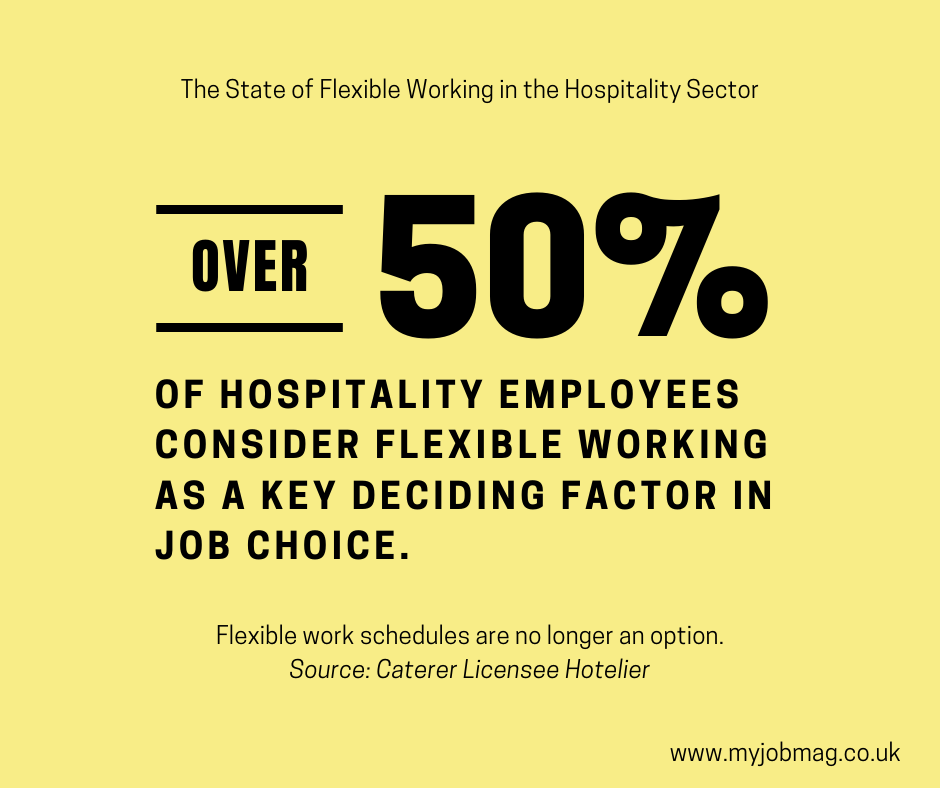
The State of Flexible Working in the Hospitality Sector
4. Widening the Lens (Who Are You Ignoring?)
If you are only fishing in a pool of 20-something school leavers, you are fishing in a shrinking pond. The smartest HRs are looking elsewhere.
Older Workers
Older workers (50+) are often more reliable, have better soft skills, and are looking for social interaction and supplementary income rather than just a career ladder. Here’s how to attract them:
- Language Matters: Avoid ads that say "energetic team" or "fast-paced party vibes." Use terms like "supportive environment," "reliable," and "customer-focused."
- Benefits Adjustment: A 21-year-old wants a discount on drinks; a 55-year-old might prefer a healthcare cash plan or enhanced pension contributions.
International Talent (Post-Visa Changes)
With visa salary thresholds rising, bringing in entry-level staff from overseas is harder. However, for skilled roles (Senior Chefs, GMs), the investment is often still worth it compared to the cost of a vacant revenue-generating position.
HR Tip: Partner with legal experts to understand the "shortage occupation list" nuances. Sometimes, paying the higher visa fee is cheaper than losing £5,000 a week in lost revenue because your restaurant is closed due to a lack of staff.
5. Onboarding is Your Retention "Vaccine"
The first 90 days are critical. High turnover often happens because the job sold didn't match the reality, or the new hire felt lonely. Here are some tips that will help you:
- Send a Welcome Text: "Hey Sarah, so excited for you to start on Monday! The team is looking forward to meeting you."
- The Digital Welcome Pack: Send a PDF with photos of the team, a map of where to park, and the dress code before they arrive. Anxiety is the enemy of retention.
- The "Buddy" System: Assign a peer mentor who is not their manager. Someone they can ask, "Where do I actually put my bag?" or "When do we really take breaks?" This human connection anchors them to the business.
6. Data-Driven HR (Stop Guessing)
You likely track food waste and room occupancy with forensic detail. Do you track your recruitment metrics the same way? If you don't, it's important to start tracking metrics that matter, such as:
- Time-to-Hire: How many days from "Job Live" to "Offer Accepted"? Aim to get this under 10 days for hourly roles.
- Source of Hire: Are you spending £500 on a job board but actually hiring everyone through employee referrals? Stop burning money.
- Ghost Rate: At what stage do people drop out? If 50% drop out after the phone screening, maybe your screening questions are too aggressive, or your interviewer needs training.
The Cost of a Bad Hire
Remind your finance team: A bad hire costs roughly 30% of that employee's first-year earnings in lost productivity and recruitment costs. Investing in better recruitment tools is not an expense; it is a saving.
Final Thoughts: Recruitment is a Service, Not a Process
The hospitality industry is built on service. We move mountains to make a guest feel welcome, special, and heard. It is time we applied that exact same philosophy to our candidates.
In 2026, the businesses that win the war for talent won't be the ones with the deepest pockets. They will be the ones that are fast, flexible, and fundamentally human. They will treat an interview not as an interrogation, but as a conversation. They will treat a rota not as a spreadsheet, but as someone's life schedule.
Summary Checklist for UK Hospitality HRs:
- Simplify: Is your application process mobile-friendly and under 5 minutes?
- Humanise: Does your job ad sell a culture, not just a list of duties?
- Speed Up: Are you contacting good applicants within 24 hours?
- Diversify: Are you actively targeting older workers or parents returning to work?
- Retain: Do you have a structured, welcoming onboarding plan for the first 3 months?
The market is tough, but you are tougher. By shifting from "filling gaps" to "building people," you turn recruitment from a headache into your greatest competitive advantage.

Staff Writer
This article was written and edited by a staff writer.

Leave a Comment