The retail industry is the beating heart of the global economy, yet it consistently battles a pervasive and incredibly costly challenge: employee turnover. According to the British Retail Consortium's HR Benchmark, average retail turnover rates exceed 50% annually. Also, every time an organisation replaces a salaried employee, it costs them 6 to 9 months' salary, according to the Society for Human Resource Management (SHRM). When you multiply that by dozens of roles across multiple store locations, the financial drain is staggering.
The key to reducing this turnover and building a high-performing store team does not start on the first day of training. It begins in the interview room. Too often, retail hiring managers rely on generic, outdated questions that fail to reveal how a candidate will actually perform under the intense pressure of a busy sales floor. Hiring based solely on a friendly demeanour or a well-formatted resume is a gamble most retailers cannot afford to take.
To hire employees who will drive sales, champion your brand, and build long-term careers within your company, you must master the art of the interview. This comprehensive guide will explain exactly how to ask the right questions during a retail recruitment interview, providing practical insights, psychological cues, and proven frameworks to help you identify and secure top talent.
Before diving into the specific questions you should be asking, it is important for you to understand why standard interview scripts fail in a retail context. Retail is a highly unique environment. It demands a delicate blend of hard skills, such as operating complex Point of Sale (POS) systems or executing precise visual merchandising, alongside critical soft skills like deep empathy and conflict resolution.
A resume might tell you that a candidate operated a cash register for two years. However, a piece of paper will never tell you if they panicked when the checkout line stretched out the door, or if they greeted every customer with genuine, infectious enthusiasm.
Asking the right questions allows you to achieve three critical objectives:
You cannot ask the right questions if you do not know exactly what you are looking for. Walking into an interview blind or simply "winging it" is a guaranteed recipe for a bad hire.
Sit down with your management team and list the three to five most critical skills needed for the specific open role. You must differentiate between positions. Is this a stockroom position where meticulous organisation, spatial awareness, and physical stamina are paramount? Or is it a front-of-house sales role where verbal communication, active listening, and upselling are the absolute priorities? Tailor your entire question bank to these specific competencies.
Modern retail is rarely just about traditional in-store transactions anymore. Today's associates are often hybrid workers. They may need to handle "Buy Online, Pick Up In Store" (BOPIS) orders, process complex digital returns, utilise mobile tablets to check inventory across different regional locations, or even assist with fulfilling ship-from-store online orders. Ensure your interview questions reflect the current technological and operational reality of your store.
To maintain objectivity, develop a simple scoring rubric for the core competencies you identified. As the candidate answers your targeted questions, rate their responses on a scale of 1 to 5. This will give you a quantifiable metric to compare candidates later, rather than relying solely on your "gut feeling" after a long day of back-to-back interviews.
To get the most out of your retail candidates, you must guide them to provide structured, evidence-based answers. The most effective way to accomplish this is by utilising and actively encouraging the STAR method.
When you ask a behavioural question (e.g., "Tell me about a time..."), you are looking for an answer that hits these four specific beats:
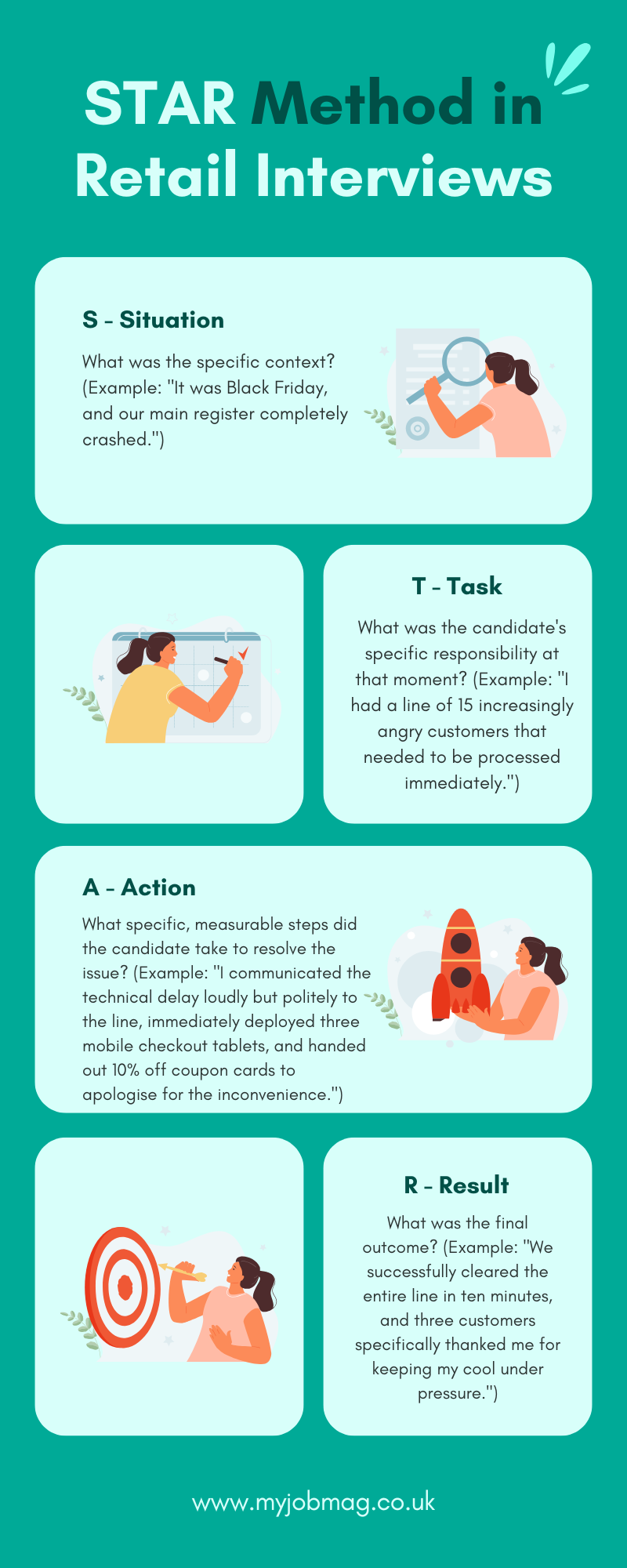
The STAR Method in Retail Interviews
If a candidate gives a vague, generalised answer, such as "I always treat customers nicely," it is your job as the interviewer to gently prompt them for a STAR response. You can say, "That is great to hear. Can you walk me through a specific example of a time you did that in a particularly difficult situation?"
To conduct a comprehensive evaluation, your interview questions should cover four main categories: Customer Service, Adaptability, Sales and Product Knowledge, and Teamwork. Below are highly effective, practical questions within each category, the psychology behind why they work, and exactly what answers you should listen for.
Exceptional customer service is the bedrock of any successful retail operation. You need employees who can effortlessly de-escalate angry patrons and create memorable, positive experiences that drive long-term brand loyalty.
Question 1: "Tell me about a time you had to deal with an incredibly frustrated or hostile customer. Walk me through how you handled the situation step-by-step, and share the final outcome."
Question 2: "Can you describe a specific time when you went above and beyond your basic job description to make a customer’s day?"
Retail environments change rapidly. Beautifully arranged displays fall over, vital point-of-sale systems crash during peak hours, and key co-workers call in sick at the last minute. You need highly resilient staff who do not freeze when the plan falls apart.
Question 3: "Imagine it is the middle of the holiday rush. The store is packed, an in-person customer is asking you a complex product question, the store phone is ringing repeatedly, and you suddenly notice a liquid spill in the main aisle. Walk me through exactly how you prioritise these tasks."
Question 4: "Tell me about a time you were given a critical task or a daily goal without clear instructions from management. What steps did you take to figure it out?"
If you are hiring for a sales-driven role, candidates must be entirely comfortable driving revenue, discussing money, and meeting Key Performance Indicators (KPIs) such as Units Per Transaction (UPT) or Average Transaction Value (ATV).
Question 5: "Walk me through how you approach a customer who immediately says they are 'just browsing' to gently encourage a sale without coming across as pushy."
Question 6: "Describe a time you had to learn the features of a completely new product line or operating technology very quickly. What was your specific learning strategy?"
A retail store operates exactly like a sports team. If one person does not show up or refuses to pull their weight, the entire shift suffers, and the customer experience degrades rapidly.
Question 7: "Tell me about a time you had to work alongside a colleague who was consistently not pulling their weight or doing their fair share of the work. How did you handle it?"
Even with the absolute best questions at your disposal, you must know how to properly interpret the answers. Here is a quick reference table to help you cleanly separate top-tier retail candidates from potential bad hires.
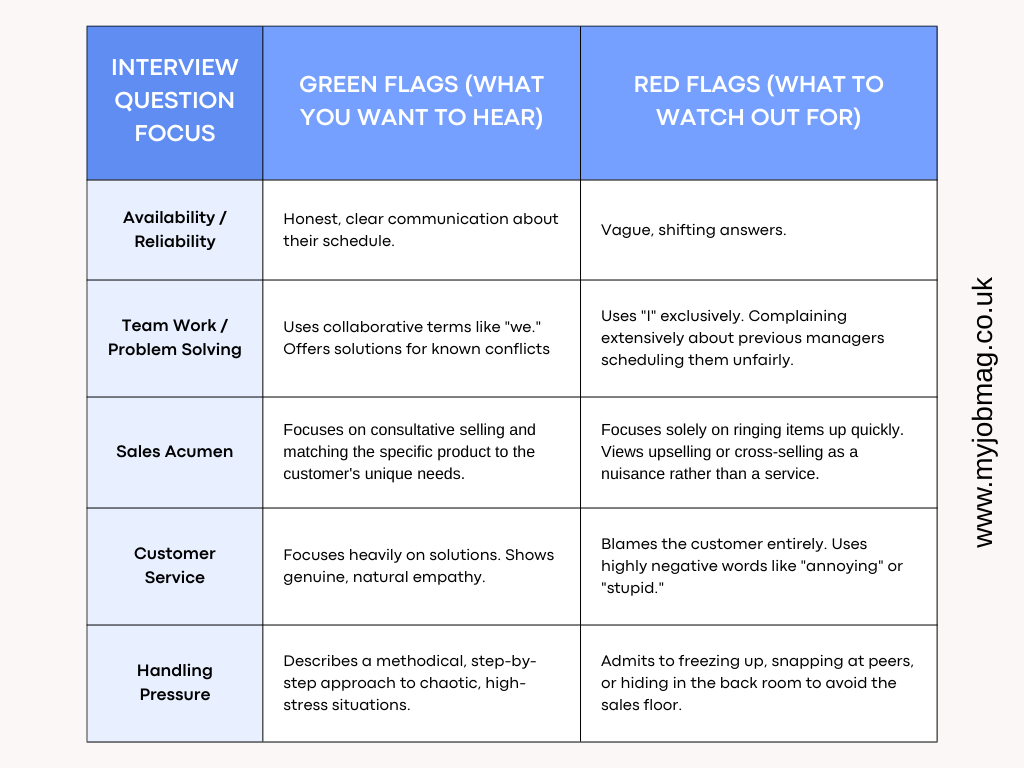
Interview Questions Green Flags and Red Flags
While knowing exactly what to ask is vital for building a great team, knowing what you must avoid asking is equally important to protect your business from severe legal liabilities. In retail, where you frequently interview a massive, diverse pool of applicants spanning different ages, backgrounds, and lifestyles, strict adherence to Equal Employment Opportunity (EEO) laws is mandatory.
Avoid any questions related to the following protected categories:
Sometimes, the most revealing question in an interview isn't a verbal question at all. It is a live demonstration. Retail is a highly interactive, kinetic job, and incorporating a brief, low-stakes roleplay into the interview process can provide unparalleled insights into a candidate's natural abilities.
How to execute a retail roleplay:
Hand the candidate a random, mundane item from your desk (a pen, a coffee mug, or ideally, an actual core product from your store) and say: "I am a customer who just walked into the store looking for a gift. Sell this item to me."
What this practical assessment reveals:
This exercise tests their on-the-spot critical thinking, their baseline comfort level with initiating a conversation, and their natural sales intuition. Pay attention to their strategy. Do they just list boring features ("This mug holds eight ounces of coffee"), or do they sell compelling benefits ("This mug is double-walled stainless steel, so it will keep your coffee piping hot during your entire morning commute")? Do they ask you questions about who the gift is for to tailor their pitch?
An interview should never be a one-sided interrogation. It should be a dynamic, two-way conversation. The questions a candidate asks you at the end of the session can be just as revealing as the answers they provided earlier.
At the conclusion of the interview, always leave five minutes to ask: "What questions do you have for me about the role, the store, or the company?"
Great candidate questions to look out for include:
These types of questions clearly indicate that the candidate is already visualising themselves in the role, cares deeply about their performance, and is looking for a long-term fit rather than just a quick paycheck. If a candidate has absolutely no questions, it may indicate a lack of preparation, critical thinking, or genuine interest in your specific brand.
Hiring the right retail staff is one of the most impactful, cost-effective ways to boost your store's profitability, vastly enhance the customer experience, and create a positive, low-turnover workplace culture. By moving far beyond generic inquiries and asking targeted, behavioural, and situational questions, you can cut through the standard interview jitters and discover who a candidate truly is and how they will perform when the store gets busy.
Remember to prepare thoroughly before they walk in the door, listen actively for the STAR method in their responses, watch carefully for behavioural red flags, and always allow the candidate the space to ask their own questions. When you invest the proper time and strategy in asking the right questions during the recruitment process, you will spend significantly less time managing frustrating turnover and significantly more time celebrating smashed sales goals with a team you trust.

Hello, we are a team of experienced recruiters and we are happy to help you recruit your next team member.
07985672434
Leave a Comment